
Running a Check in Wisconsin
The Wisconsin Department of Corrections Sex Offender Registry Program, known as SORP, administers the official public registry. Its free search covers people whose status falls within Wis. Stat. § 301.45. That group can include qualifying convictions, juvenile adjudications, certain mental-disease findings, Chapter 980 commitments, and comparable dispositions from other jurisdictions. It is not a list of every person ever accused of a sex offense. An arrest or charge alone is not the same as a qualifying final disposition.
The Wisconsin registry combines authorized information from all 72 counties. DOC maintains the statewide entry. Local law enforcement supports compliance and community notice. The registry is therefore the right first stop for statewide checking, yet it is not a full rap sheet. An absent result does not prove that no relevant case existed. A listed conviction does not state present dangerousness. The court judgment remains essential context.
Wisconsin Registry Coverage Limits
Wisconsin law controls inclusion. The operative program date is December 25, 1993. Comparable federal, military, tribal, foreign, or out-of-state dispositions may create duties when a person lives, works, studies, or is otherwise covered in Wisconsin. Attempts, conspiracies, and solicitations can matter when the statute reaches them. Offense titles also change over time. Compare the judgment and statute instead of relying on a short label.
Public display is narrower than what DOC collects. Victim identity is excluded. Juvenile details and Internet identifiers receive special limits. Other confidential data stays private. Wisconsin's registry publication law controls what DOC may release online. A blank field might mean withheld, not applicable, not collected, or not yet processed. It is not safe to treat each blank as a negative answer.
The official Wisconsin registry interface visibly separates this public safety tool from a general criminal record search.
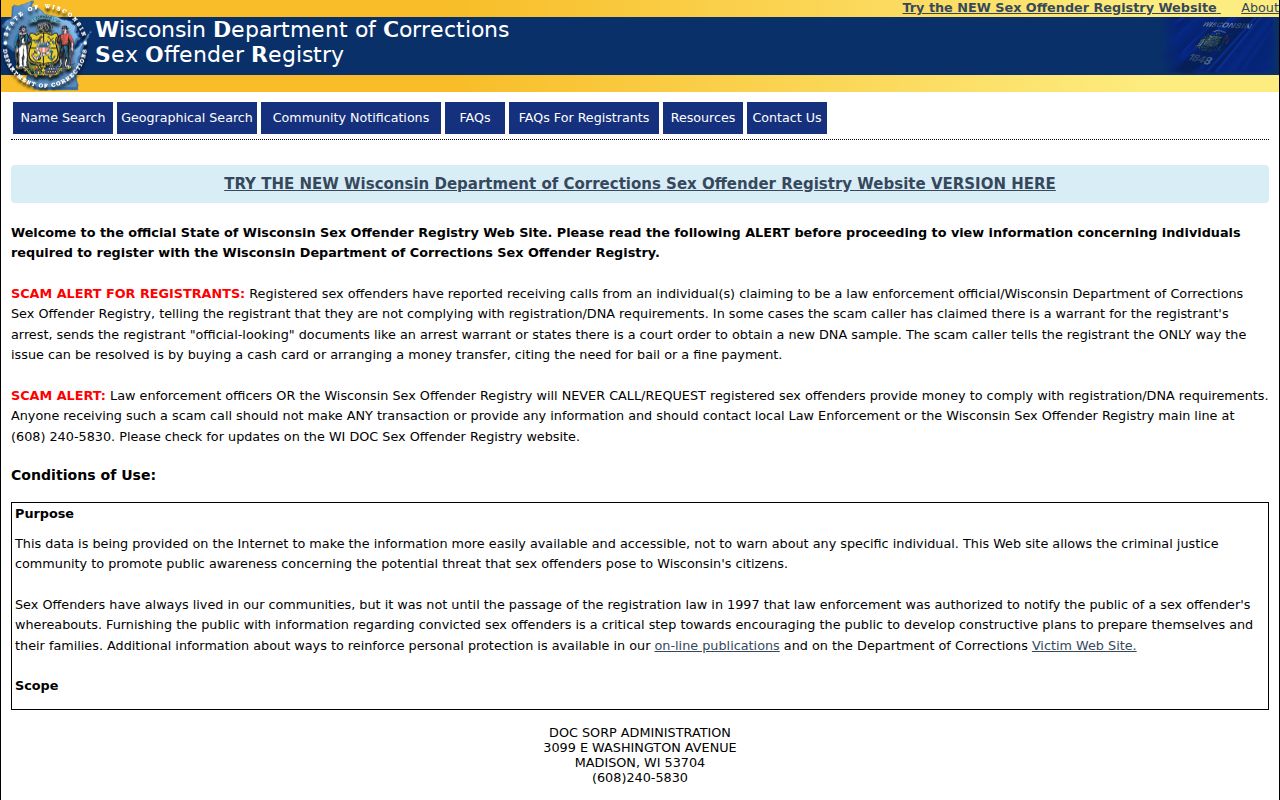
Its terms and separate search modes reinforce the registry's narrow statutory purpose.
Searching the Wisconsin Sex Offender Registry
Public access requires no account and carries no search fee. First accept the terms and complete the anti-automation check. Choose a name search when an identity is known. Choose a geographic search to review publishable registered locations around a Wisconsin place. Begin with the smallest set of reliable facts. Expand only when needed. A common name can return several people, while a narrow spelling can miss an alias.
- Open the official Wisconsin Sex Offender Registry and accept its terms.
- Select Name Search or Geographic Search, then enter reliable criteria.
- Open each possible match and compare the photograph, aliases, physical traits, location, and offense jurisdiction.
- Use a community alert for ongoing place-based notice, or NSOPW when a search may cross state lines.
| Field Label | Type | Required | Notes |
|---|---|---|---|
| Last Name | Text | Yes in name mode | Try a known alias or surname alone if needed. |
| First Name / Middle Initial | Text | No | These narrow the name results. |
| Street / City / ZIP | Text | Conditional | These establish a geographic search point. |
| County | Dropdown | No | Filters reported location, not the conviction county. |
| Radius | Dropdown | No | Available choices are one, two, or three miles. |
| Email Community Alert | Subscription | No | A monitoring notice, not emergency dispatch. |
DOC also supplies a neutral profile interface for reviewing a selected Wisconsin registry result.
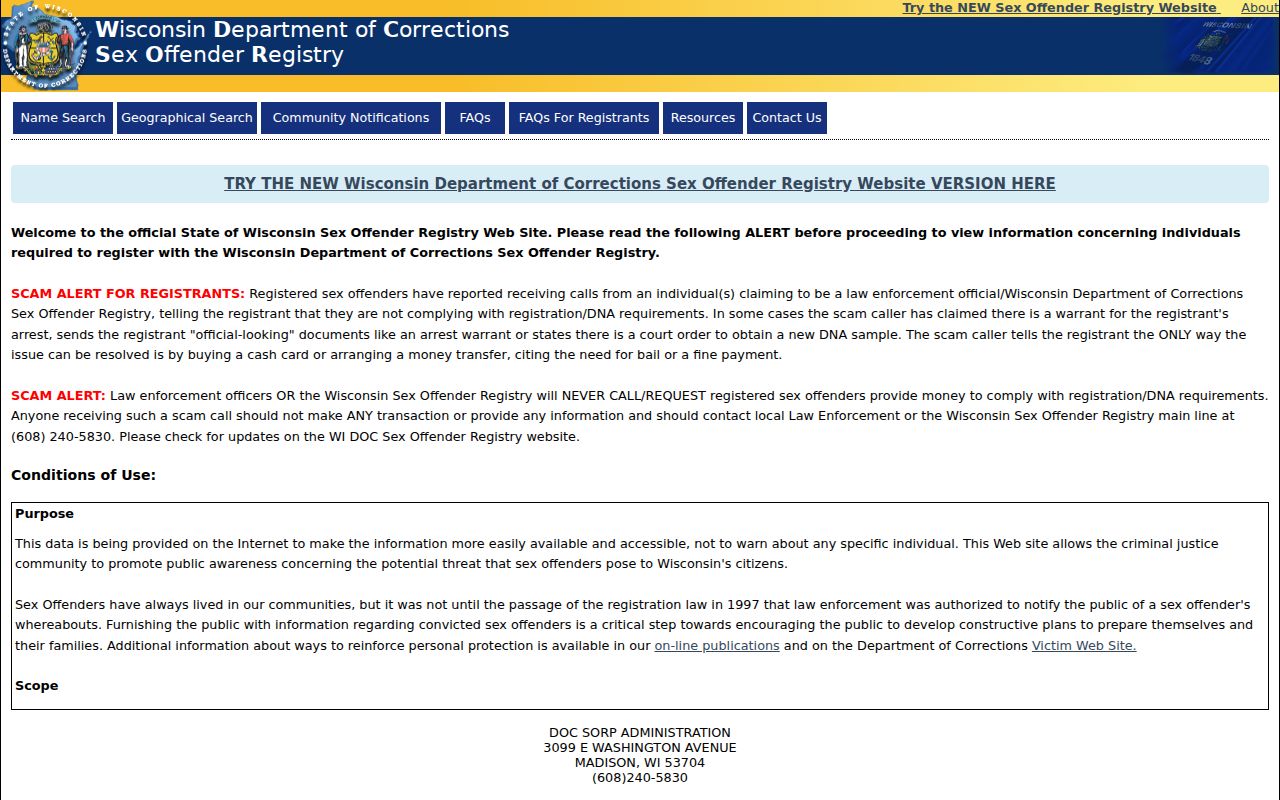
The layout makes descriptor checks vital before drawing any conclusion from a name.
Wisconsin Radius Results Need Context
A map pin represents processed registry location data. It does not prove that a person is standing at that point now. Geocoding can be imprecise. An address may change after its last verification. Temporary or multiple locations may need added review. Search the municipality, ZIP code, and county when one radius view seems incomplete. The county field concerns reported location, not where a conviction occurred.
Wisconsin has no single blanket rule placing every registrant the same set distance from each school, park, or child-care site. Municipal ordinances, supervision terms, Chapter 980 placement orders, and statutes can impose distinct limits. A local residency rule does not change the state registration term. Check the current municipal code and responsible local office for a specific address. Never rely on an old online zone list as the final word.
The official Wisconsin sex offender information law explains why the map is a notice tool instead of a live tracker.
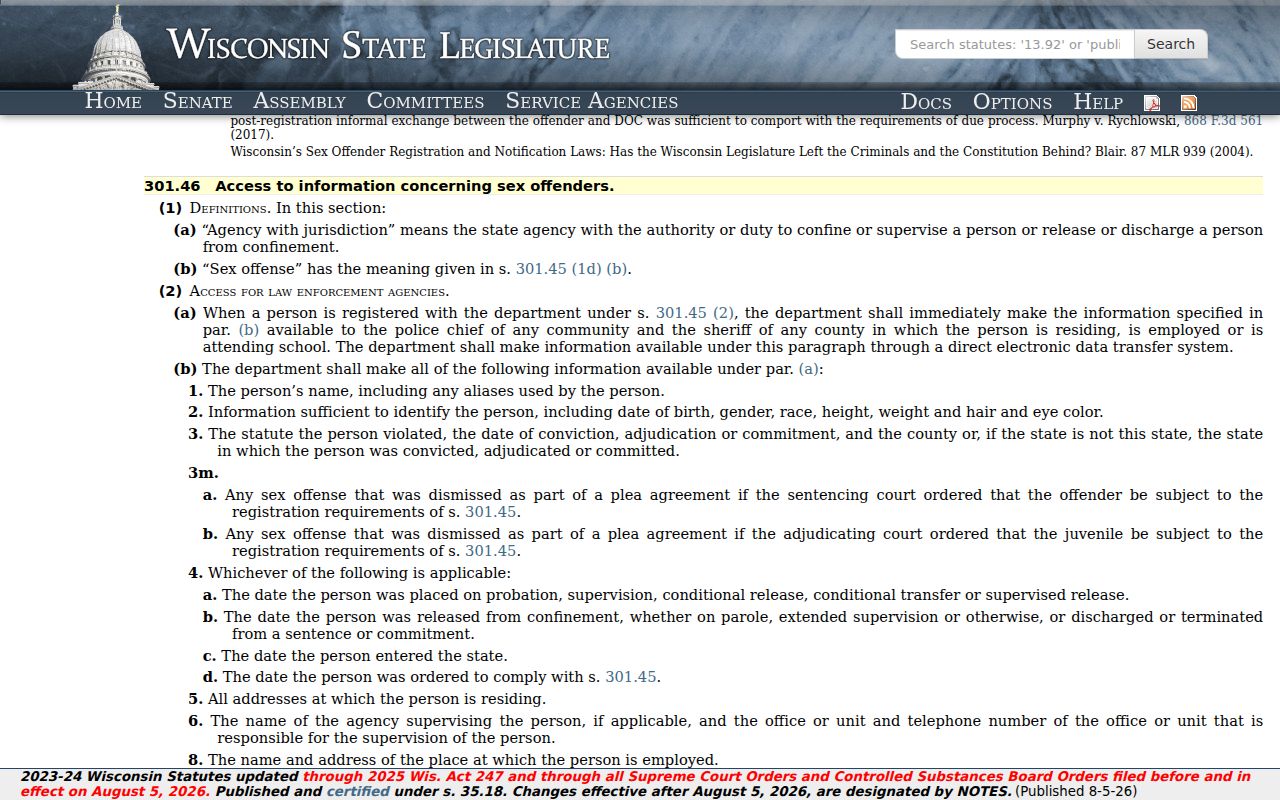
Those disclosure limits require readers to pair geographic results with the profile and current local rules.
What a Profile Shows
A Wisconsin registry profile identifies a person and displays authorized parts of the registration status. Read each field on its own terms. A compliance flag is not a conviction. A conviction line is not proof of a new offense. Corrections status also differs from registration, which can continue after supervision ends. The official county court file supplies the charge history, judgment, and later orders that a short registry line cannot show.
| Name & Aliases | Full name, other names, and a DOC or registry reference identifier. |
|---|---|
| Image & Description | Photograph and authorized age, sex, race, height, weight, hair, eyes, or identifying traits. |
| Published Location | Residence or other authorized location, municipality, county, state, and ZIP. |
| Offense Details | Qualifying offense, disposition date, court, jurisdiction, and other publishable case data. |
| Registry Status | Registration length, response or compliance status, plus a verification or update indicator. |
| Other Public Fields | Publishable vehicles, corrections status, Chapter 980 notices, and administrative warnings. |
Note: Open the Wisconsin court record before treating a short offense description, date, or compliance label as the whole case outcome.
Wisconsin Registration Outlasts Supervision
DOC's Division of Community Corrections annual report counted 27,404 registered people on July 1, 2025. That total included 26,951 adults and 453 in the juvenile or minor category. It also counted 6,374 incarcerated registrants and 6,127 under active supervision. Most striking, 14,903 had ended supervision but still owed a registration duty. The Wisconsin registry is therefore not a probation list.
The count is a dated snapshot and will change. Its lesson remains useful. Registration status, custody, and supervision answer different questions. DOC's public registry covers the first. The DOC locator and victim-notification systems address other events. A court judgment establishes the judicial basis. Use each official source for its own function.
Registration Requirements and Levels
Wisconsin does not publish a universal Tier I, Tier II, and Tier III scheme. The central duration split is generally 15 years or life. A narrower group of lifetime registrants reports at least every 90 days. It is wrong to call every lifetime registrant a quarterly reporter. Duration may depend on the offense, judgment, release, discharge, supervision, later confinement, and another jurisdiction's rules. Fifteen years does not simply mean 15 years from conviction.
| Wisconsin Category | General Duration | Verification |
|---|---|---|
| Covered person outside a lifetime category | Generally 15 years from the statutory correctional event | Most verify annually and report covered changes separately. |
| Two qualifying matters in separate proceedings | Life | Assigned schedule applies; two counts in one case are not automatically separate proceedings. |
| Specified serious, court-ordered, or other lifetime category | Life | The governing provision and DOC instructions control. |
| Chapter 980 commitment | Life | Civil commitment remains distinct from the criminal sentence. |
| Specified enhanced-reporting group | Life | At least every 90 days under § 301.45(3)(b). |
DOC sends verification material, but verification is not the only duty. Covered changes generally must be reported within ten days. Identity, residence, lodging, school, work, vehicles, telephone, and Internet information can be involved. A person under supervision may face a shorter residence-notice rule. Current SORP instructions control.
Wisconsin Registry Alerts Differ
Community alerts, Special Bulletin Notifications, local notices, and victim-status notifications are separate tools. A geographic email subscription monitors qualifying registry activity near chosen criteria. It is not emergency dispatch. A Special Bulletin Notification can support targeted local dissemination under § 301.46, but one is not issued for every registrant. NOTIS concerns custody or supervision events rather than a neighborhood radius.
For cross-state searching, the U.S. Department of Justice NSOPW combines participating jurisdictions. It does not replace Wisconsin DOC for Wisconsin details.
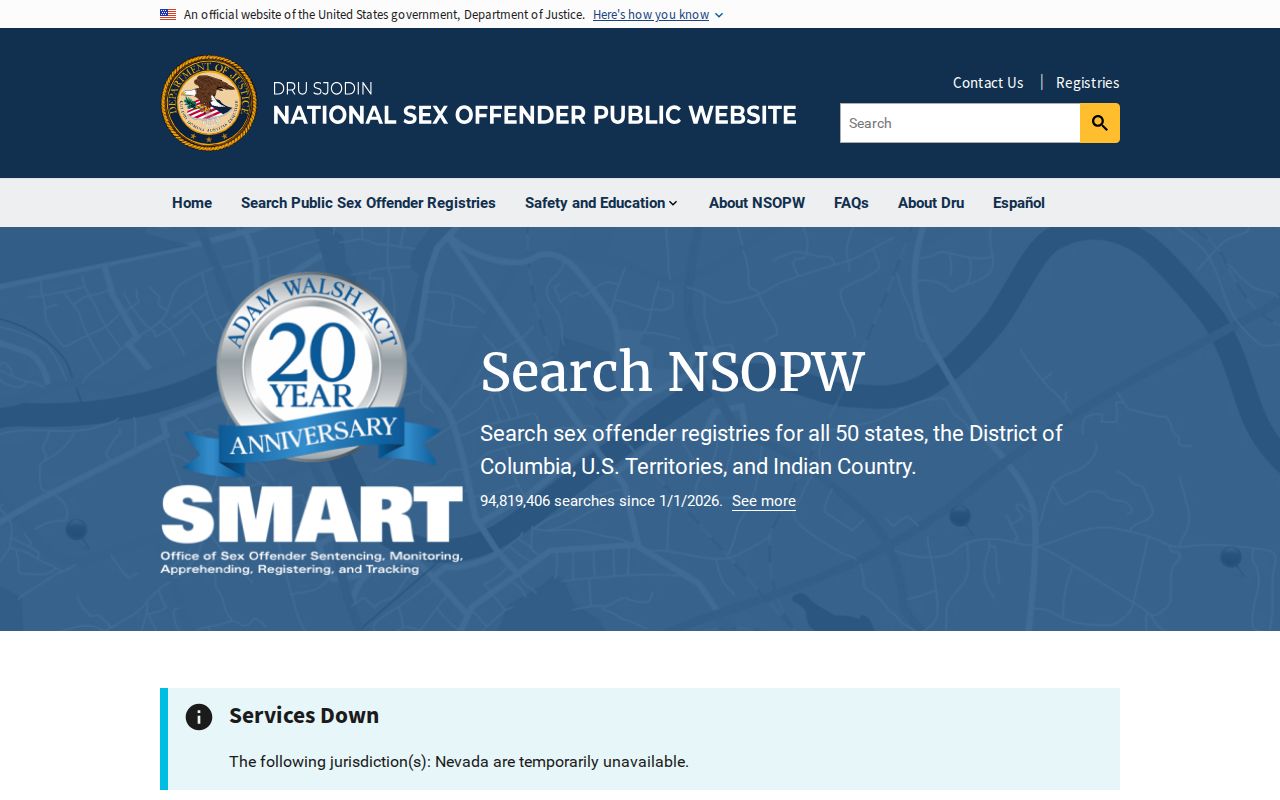
The national layer helps near a border, while the originating state profile remains the detailed source.
Wisconsin Registry to Court File
A registry entry is not a case file. Start with its court, jurisdiction, offense, and disposition date. Then check WCCA for the eligible public docket. WCCA does not place every public document online, and confidential or expunged matters follow separate display rules. Older online coverage can vary by county and conversion history. Ask the clerk of circuit court in the filing county for the official complaint, judgment, orders, and any available certified copy. The clerk can explain the court record, but DOC controls the statewide registry display.
Use the Wisconsin county directory to reach the correct local records site. Local law enforcement may hold community-notification material, and a municipality keeps its current residency ordinance. If a profile seems stale, save its URL and access date, then report the issue to SORP. Do not accuse a listed person of noncompliance based on one screenshot.
Lawful Use
The Wisconsin Sex Offender Registry supports personal, family, neighborhood, and community safety. Reasonable uses include checking an area, matching an official bulletin to a DOC profile, and helping family members recognize official information. The data does not authorize confrontation, trespass, retaliation, or publication of uninvolved household members. A map point is not an invitation to enter private land.
Registry misuse can be a crime. Do not threaten, intimidate, stalk, harass, assault, damage property, or use Wisconsin registry data to commit any crime against a listed person or associated people. Call 911 for immediate danger and use the official local non-emergency channel for other safety concerns.
Treat each result as official public information with a limited purpose. Confirm identity, read the underlying judgment, and respect both public and private boundaries.